News

The room is booked, and now it's time to choose the display. For a room where you can control the lighting, projection remains the most flexible choice, while an LED wall is justified when the room is brightly lit, when the screen is part of the set design, or when the image is being filmed.
An LED wall emits light directly to create the image, whereas a projection screen reflects light from the projector; this difference accounts for almost all variations in performance.
An LED wall is made of assembled panels. Each pixel is a diode that produces its own light, so there is no need for a lamp, a screen surface, or throw distance.
Projection pairs a projector with a projection screen—whether frame-mounted, tripod-mounted, or motorized. It can be set up for front projection or rear projection, with the projector placed behind the screen. Our large-format projection and LED wall service covers both technologies.
For an event, a blank white wall won't do; its uncontrolled gain leaves the image dull and uneven. Three elements determine screen quality. First, the fabric: a matte white surface provides the widest viewing angles for a broad room, whereas a high-gain fabric focuses light toward the centre—useful in bright spaces, but compromising off-axis viewing. Next, the frame keeps the screen taut and wrinkle-free. Finally, the mounting structure—whether flown, ground-supported, or motorized—adapts to your venue.

In a room with windows, an LED wall keeps the image legible despite daylight.
The brighter the room, the more an LED wall is the right choice. Ambient light falling on a projection screen washes out blacks and reduces the actual contrast.
An LED wall is much brighter: it remains legible near windows, in bright rooms, and under stage lighting, with an excellent viewing angle.
Projecting in a room with windows is possible with a very bright projector and light control via curtains. However, an LED wall is more reliable, and we assess the room before committing.
Projector power is sized according to image surface area, ambient light, and content type. Fine text on a white background is less forgiving than high-contrast video.
Only compare lumens measured according to the ISO/IEC 21118 standard, which averages readings across nine zones of the image. Terms like "laser lumens" or "light source lumens" don't follow this methodology and can yield significantly inflated numbers that aren't truly comparable.
For your slide templates, aim for a text contrast ratio of at least 4.5:1, in accordance with W3C Success Criterion 1.4.3. Large-scale text allows for a lower contrast ratio.
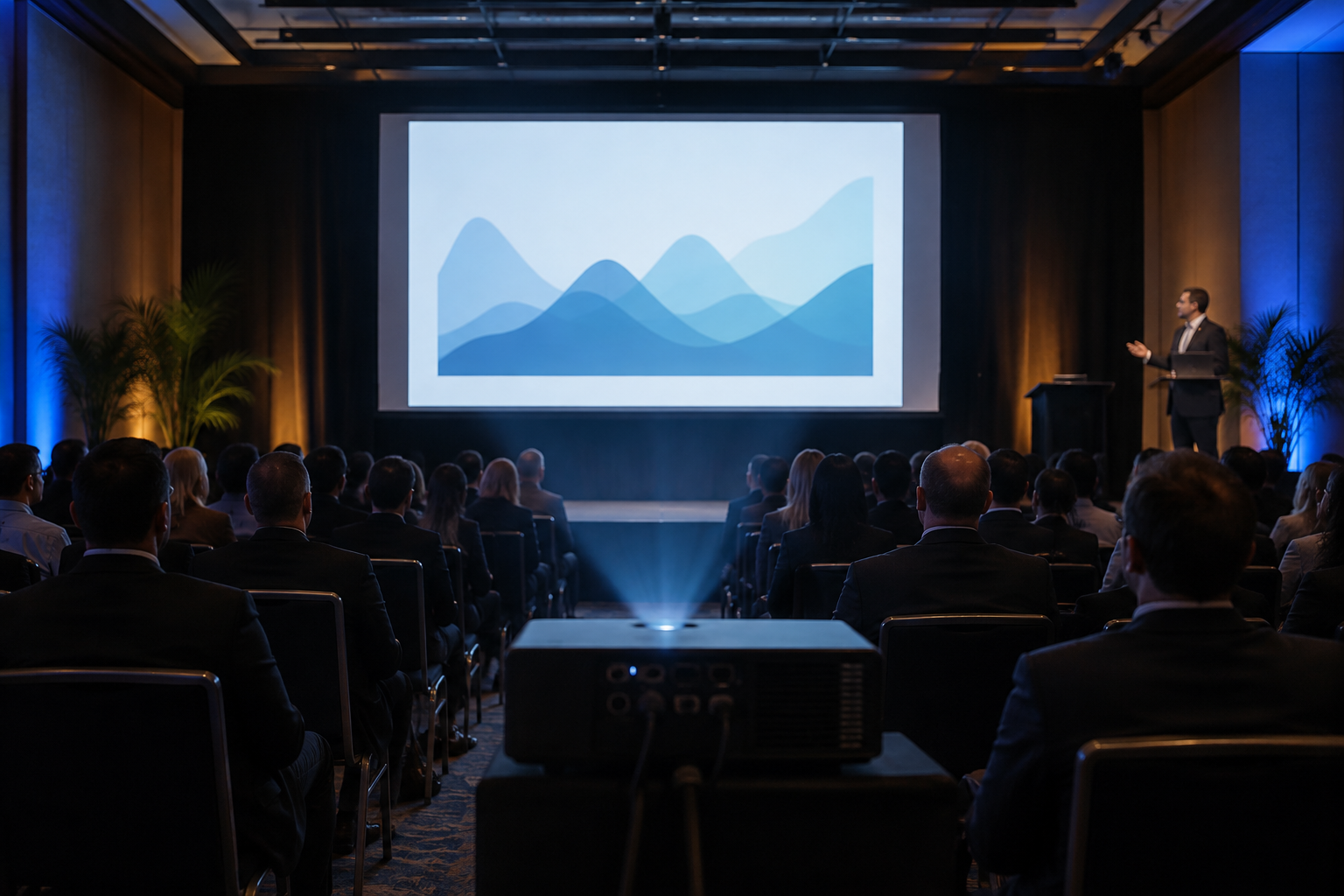
In a room where you can control the lighting, projection covers a large image area.
Image size is calculated based on the distance of the furthest viewer. Our rule: the image height should be at least one-sixth of the distance between the screen and that viewer.
A room 30 metres deep therefore requires an image about 5 metres high. For a 200-person room, plan on an image 3 to 4 metres wide, depending on room depth and content density.
The ANSI/AVIXA V202.01 (DISCAS) standard is based on the same principle. To ensure legibility and comprehension, the furthest viewer should be no more than 200 times the height of the smallest element displayed. If the back row is 20 m away, the smallest character must be at least 10 cm tall on screen.
The bottom of the image must remain visible above people's heads, which often requires a structure or a riser.
A high-quality, properly sized projection screen will always outperform an undersized LED wall.
The pixel pitch is the distance, in millimetres, between the centres of two adjacent LEDs. It dictates both resolution and the minimum viewing distance.
The industry rule of thumb: the minimum distance in metres is roughly equal to the pixel pitch in millimetres. With a 2.6 mm pitch, the first row should therefore be at least 2.6 m from the screen.
The finer the pitch, the sharper the image remains up close, but the more expensive the wall: always ask for the pitch before comparing quotes.
Stage depth limits front projection, as the projector requires sufficient throw distance or a rear-projection setup.
When the stage is shallow, we use short-throw lenses. When the projector is at the back of the room, we choose a long-throw lens.
LED walls come in unconventional formats, such as a very wide banner or a full stage backdrop. Projection also offers varied configurations: single screen, dual side screens, panoramic screens created by multiple projectors with edge-blending, or auxiliary screens in the room.
Content designed in a standard wide format on an ultra-wide screen leaves two empty bars, and the reverse crops the titles. We verify presentation templates before the event.
Cameras don't react the same way to both technologies. Filming an LED wall can cause moiré patterns or scan lines, depending on the camera, shutter speed, and the wall's refresh rate. This can be resolved during pre-event testing by fine-tuning the camera settings.
Projection can be filmed without this pattern. However, it often appears washed out if stage lighting spills onto the screen.
For webcasting and hybrid events, we route content directly into the broadcast feed rather than filming the screen. With multi-camera video production, the camera feed can also be displayed live on screen—a practical asset for larger venues.
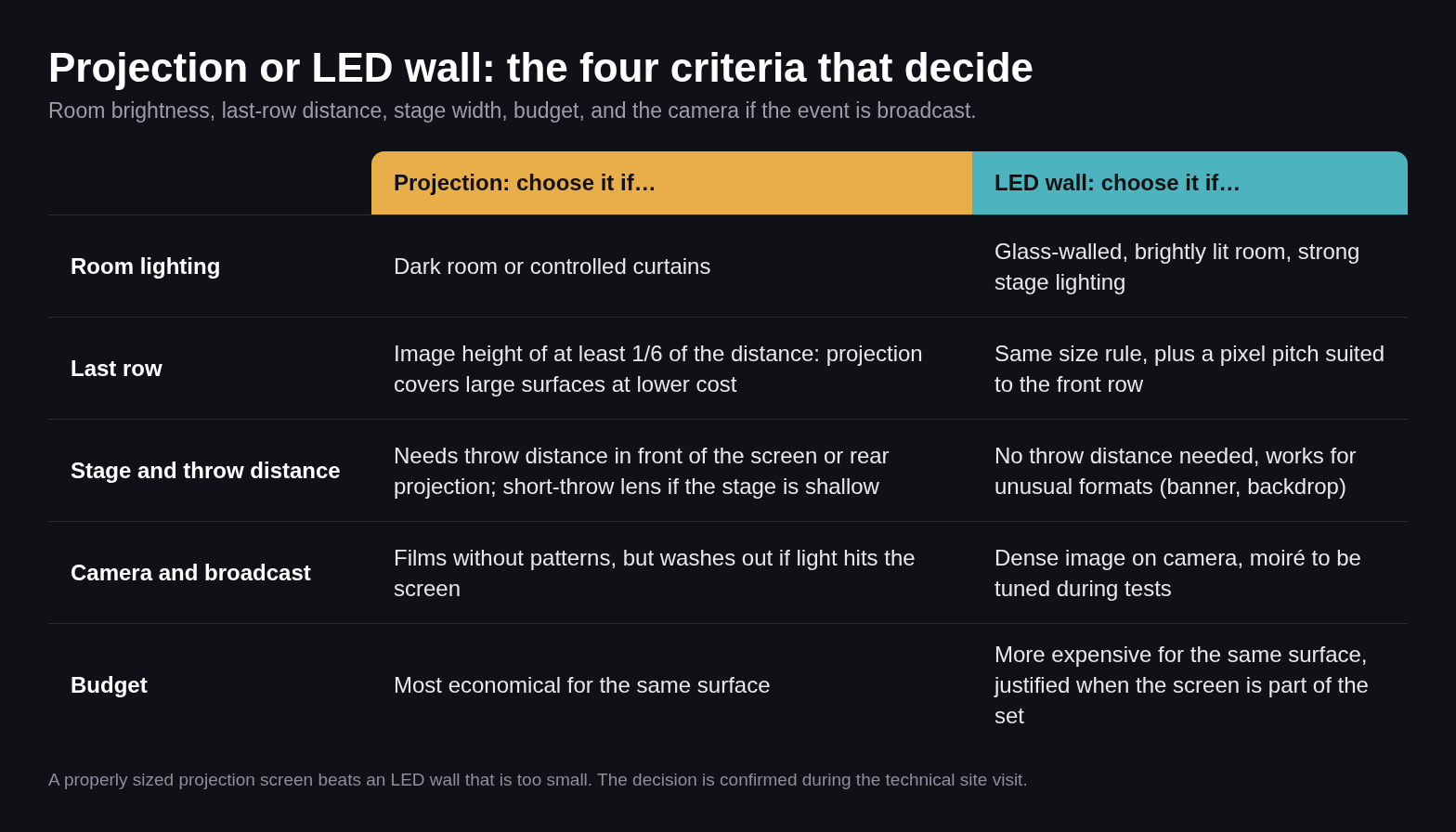
Criteria for choosing between projection and LED walls.
An LED wall is more expensive than projection for an equivalent display area. Several other factors influence the quote:
Each item is listed separately in our quote. No prices are published here, as they depend on these variables.
We recommend a site visit, ideally 3 to 4 weeks ahead of a convention or gala. This allows us to measure ambient light, throw distance, and ceiling height. We can easily work with the venue's existing in-house gear and supply whatever else is needed.
Audio, lighting, projection, and video are managed by a single team, with a unified control booth and one dedicated point of contact. Backup sources and redundant computers are built in as standard. You can request a detailed quote, delivered within 24 hours.


Customized audiovisual solutions for immersive corporate events.